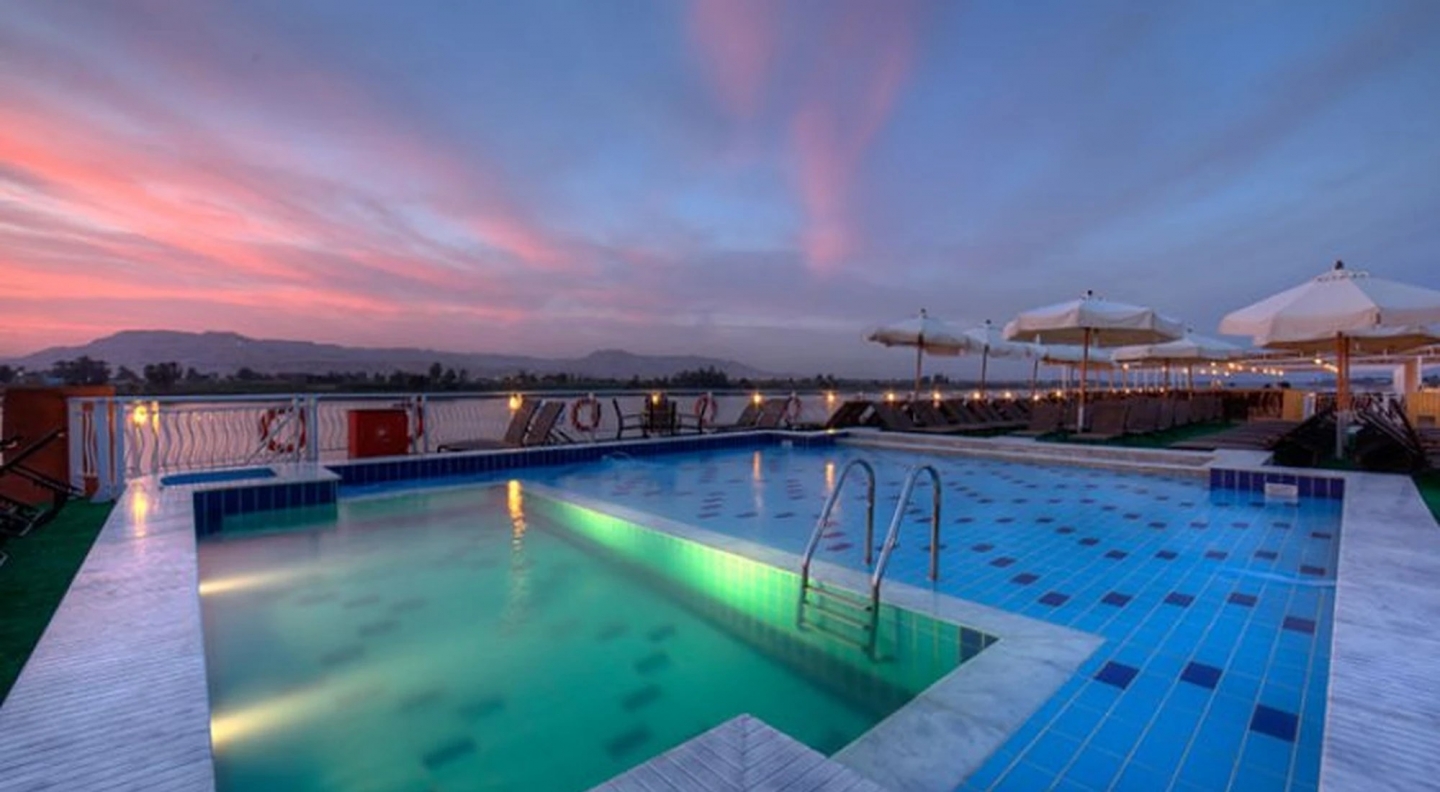


The Steigenberger Minerva has 77 cabins, a pool and a gym, and sails five days from Luxor to Aswan, visiting Karnak, Edfu, Kom Ombo and Philae.
You board and settle into your cabin before lunch. The afternoon is the East Bank: the Karnak Temple Complex covers 100 hectares, with rows of ram-headed sphinxes at the entrance, enormous pylons, and the Hypostyle Hall, whose 134 columns are packed close enough to lose people between. Luxor Temple follows, joined to Karnak by the ancient Sphinx Avenue and fronted by colossal statues of Ramses II. Afternoon tea back on board, then dinner.
Across the river after breakfast to the Valley of the Kings, where generations of pharaohs lie in painted chambers cut deep into the rock; the tombs of Tutankhamun and Seti I can be added separately. Then the Temple of Queen Hatshepsut with its terraces cut into the cliff, and the Colossi of Memnon, which once stood at the entrance to Amenhotep III's temple. Lunch on board as the ship starts for Esna, and passing through the Esna Lock is worth watching from the deck.
A carriage ride through the streets of Edfu to the Temple of Horus, the best-preserved ancient temple in Egypt, whose pylons and reliefs set out the long fight between good and evil in a form you can follow wall by wall. Lunch on board, then Kom Ombo, the temple shared between Sobek and Horus the Elder, with the Crocodile Mummification Museum next door and its dozens of preserved animals.
The High Dam first, with Lake Nasser spread out behind it. Then a motorboat across to Philae Temple, the island sanctuary of Isis, whose columns are among the best preserved in Egypt and whose setting is the reason people photograph it more than they photograph the building. The morning finishes at the Unfinished Obelisk in the granite quarries. Lunch on board, and the afternoon is free.
Optional: A felucca ride around Elephantine Island
A last breakfast on board before you disembark.
Optional: An excursion to Abu Simbel by car or by flight, at extra cost, for the rock-cut temples of Ramses II and Queen Nefertari, moved stone by stone to keep them clear of the water